


Curriculum
Where knowledge becomes confidence, and confidence changes lives.
The Internal Medicine Residency curriculum was designed to meet our program mission and aims using the following key components: 1) rotations, the foundational (required) and individual educational experiences (electives); 2) the conferences and educational activities that occur on a daily, weekly and monthly basis and 3) our longitudinal curricular thread.
A Curriculum Built on Balance
13
4-week blocks each academic year
18
electives
18
months of core didactic curriculum
0
overnight calls
Schedule Model
The schedule of rotations has been developed on the foundation of balancing robust training and exposure across the Internal Medicine specialties with resident and faculty well-being and achieving an appropriate work-life balance.
As we utilize a night float system, there is no overnight call for the duration of the program. Residents instead do one block each academic year of night float, working with the nocturnist in house overnight.
We believe the traditional curriculum model with thirteen 4-week blocks each academic year, with ongoing weekly continuity clinic (one half-day each week) best suits our program and culture. This schedule format minimizes the changes between rotations, allows for significant attending exposure on any rotation, and allows for continuity within the clinic experience with consistency of scheduling. It also allows for weekends off during outpatient elective rotation.
| Rotation | Duration | Setting |
|---|---|---|
| Inpatient Wards | 6 blocks PGY-1, 4 blocks PGY-2, # blocks PGY-3 |
Inpatient |
| ICU | One block each academic year | Inpatient |
| Night Float | One block each academic year | Inpatient |
| Cardiology | One block | Inpatient / Outpatient |
| Pulmonology | One block | Inpatient / Outpatient |
| Endocrinology | One block | Outpatient |
| Gastroenterology | One block | Inpatient / Outpatient |
| Nephrology | One block | Inpatient / Outpatient |
| Neurology | One block | Inpatient / Outpatient |
| Infectious Diseases | One block | Inpatient / Outpatient |
| Rheumatology | One block | Outpatient |
| Geriatrics | One block | Outpatient |
| Emergency Medicine | One block | Inpatient / Outpatient |
| Hematology / Oncology | One block | Inpatient / Outpatient |
| Elective Time – Resident Choice of Rotation | Two blocks each academic year | Inpatient / Outpatient |
Inpatient experiences will occur at MUSC Health Columbia Downtown Medical Center. Any inpatient elective experience will have at most two residents (most often just one) working directly with an attending.
- Inpatient medicine – two floor medicine teams.
- ICU – one team
- Outpatient clinic – two to three residents at most for half day with the clinic attending.
- Any outpatient elective experience will have at most two residents (most often just one) working directly with an attending
Note – subspecialty electives that are hybrid inpatient and outpatient may have the resident working with a different attending in each venue.
Due to the intense nature and extensive patient care and educational requirements of training in internal medicine, we do not allow moonlighting at this time. Of note, there are financial incentives available through the QI incentive program that can supplement income.
- Cardiology
- Advanced heart failure
- Pulmonology
- ICU / critical care
- Nephrology
- Gastroenterology
- Endocrinology
- Neurology
- Geriatrics
- Rheumatology
- Infectious Diseases
- Hematology / Oncology
- Primary Care
- Dermatology
- Ophthalmology
- ENT
- Allergy / Immunology
- Research
| Monday | Tuesday | Wednesday | Thursday | Friday |
|---|---|---|---|---|
| Noon to 1:45 p.m. Noon Report / Journal Club / Quality Clinical Care Review / Case of the Month / Program Director Forum |
Noon to 1:45 p.m. Didactic Lecture |
Noon to 1:45 p.m. Didactic Lecture / Wellness Wednesday |
Noon to 1:45 p.m. Didactic Lecture |
Noon to 1:45 p.m. Board Review / Didactic Lecture |
Conference & Educational Activities
Frequency: Once per week
Resident driven with faculty facilitator review of MKSAP questions geared for preparation for the ABIM exam.
Frequency: Once per month
A resident-driven in-depth look at a unique patient case that demonstrates a rare diagnosis, a difficult care course, or unique medical decision-making case.
Frequency: 3 to 4 times per week
This 18-month curriculum is designed to cover the core topics in internal medicine and intentionally uses repetition to allow learners to interact with the content at the introductory and more advanced levels and the opportunity to revisit and consolidate knowledge as they grow in clinical experiences and exposure. This series is run primarily by the core faculty and augments learning in the clinical setting.
Frequency: Once per month
Resident-led with faculty facilitator to review new and seminal journal articles relevant to internal medicine with a focus on appraisal of the medical evidence and practice ramifications.
Frequency: 3 times per week
Interactive case-based discussion of unique and/or challenging cases to develop clinical reasoning and decision making.
Frequency: Once per month
Dedicated face time for the group of all residents to receive updates from and voice concerns to the program director.
Frequency: Once per month
Morbidity and mortality conference that looks at a real patient case with a focus on opportunities for improvement in the quality of overall care.
Frequency: Once per month
A Wednesday noon conference dedicated to all things wellness for resident well-being.
Scholarly Project
MUSC Health Columbia Downtown Medical Center in partnership with MUSC-RN provides and allocates various resources to encourage and facilitate resident and faculty participation and completion of scholarly activities. Throughout the three years of training residents are required to participate in various quality improvement and patient safety initiatives to advance their knowledge of and implement a scholarly approach to evidence-based patient care.
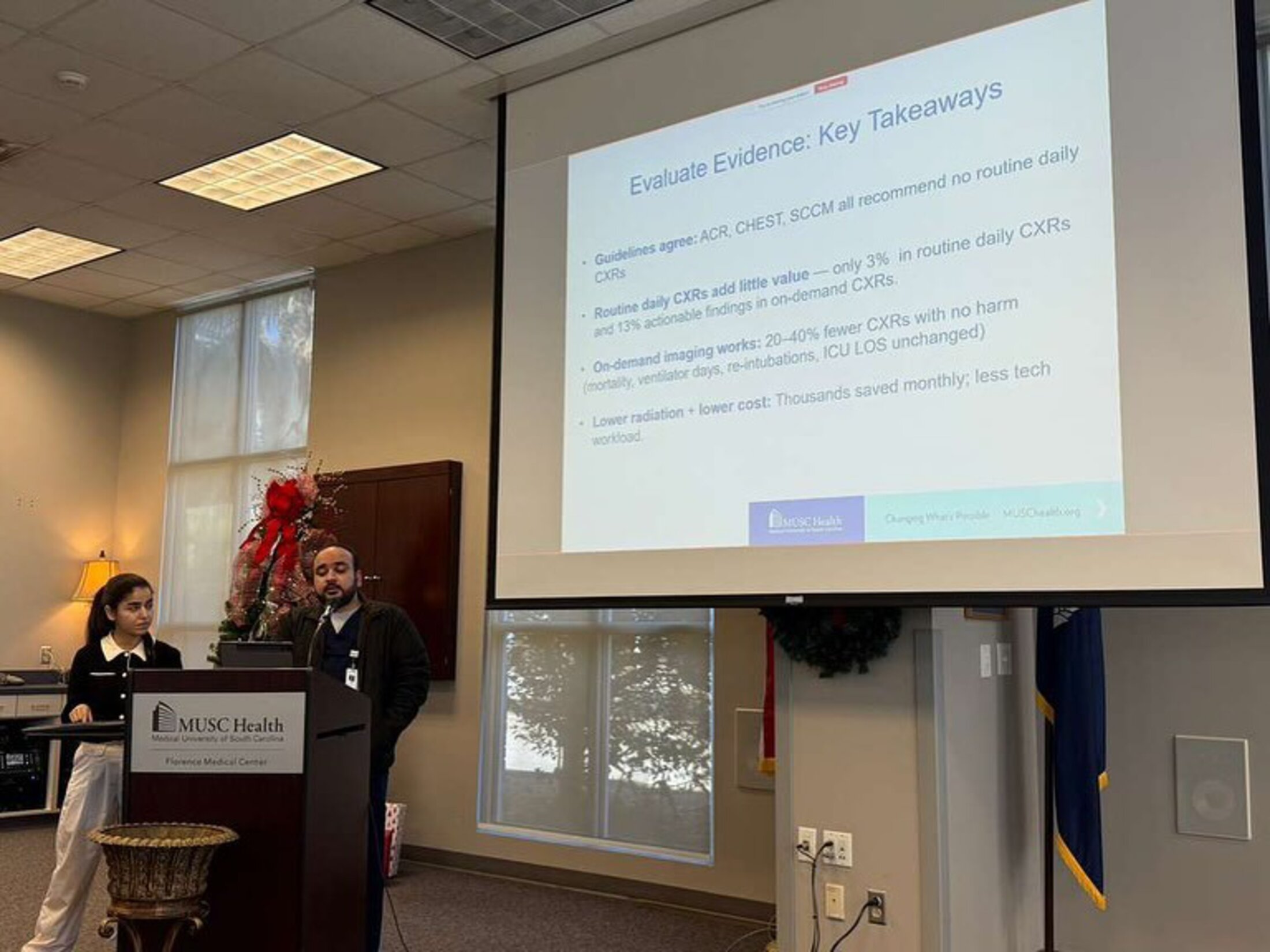
Residents are provided, annually, educational travel allowances to present their findings at local, regional, and national conferences.
Faculty, many of whom already participate in such activities, serve separately as a mentor or supervising physician for at least one resident activity annually.
MUSC Health Columbia Downtown Medical Center core faculty are afforded resources to participate in scholarly activities and will demonstrate participation in:
- Research in basic science, education, translational science, patient care, or population health
- Peer-reviewed grants
- Quality improvement and/or patient safety initiatives
- Systematic reviews, meta-analyses, review articles, chapters in medical textbooks, or case reports
- Creation of curricula, evaluation tools, didactic educational activities, or electronic educational materials
- Contribution to hospital and professional committees, educational organizations, or editorial boards
- Innovations in education
Residents are provided with lectures in research fundamentals to include basic statistics, medical writing, study design, literature review and data collection and interpretation, developed and delivered by the MUSC Department of Population Health faculty, MUSC Medical Librarian, and the program faculty.
Each resident is expected to complete one scholarly project as a requirement for graduation. Activities can include quality improvement, clinical/basic science research, review articles, case series, or any presentation at a local, regional or national meeting. The program will ensure the resident completes this requirement using an Individualized Learning Plan, with scholarly activity being one of its components.
The specific steps to completion are:
- identifying a topic,
- engaging a faculty mentor,
- submitting an approved plan for scholarly activity,
- completing a scholarly activity product (article, abstract, presentation slides and evaluations as applicable)
- ILP completed by the resident and approved by the Faculty Mentor and tracked in MedHub
Progress and completion of the scholarly activity will be reviewed in the resident meetings with their advisors and the semi-annual meetings with the program director.
PGY-1 residents will participate in MUSC Value Institute Evidence-Based Quality Improvement (EBQI) curriculum and present project findings to MUSC-RN and MUSC Health Leadership.
All residents will participate, annually, in one group project for submittal to the MUSC Resident Incentive Program (RIP). Project participants, upon fulfilling the guidelines of the program will be provided a monetary award for successful completion.
