


Non-Invasive
We will train you to be a competent entry-level cardiovascular technologist in the cognitive, psychomotor, and affective learning domains for adult echo cardiography and non-invasive vascular sonography.
Become a Certified Cardiovascular Technologist
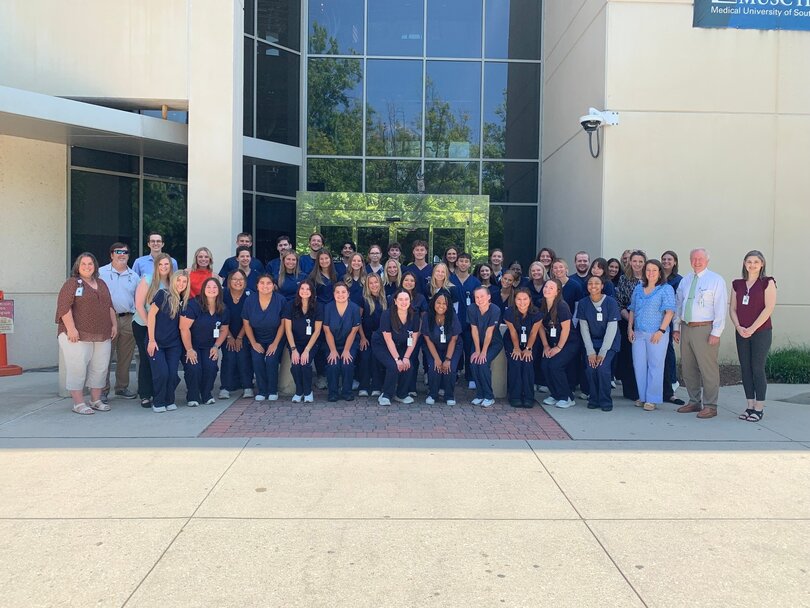
At MUSC Health's Claude W. Smith, M.D. School of Cardiovascular Technology, we're dedicated to training the next generation of cardiovascular professionals. The demand for qualified technologists is skyrocketing, and we offer rigorous, hands-on programs to prepare you for a rewarding career in this essential field. Choose one of our 17-month Cardiovascular Technology programs or our specialized 12-month Electrophysiology program. As a school within MUSC Health, we provide a unique, real-world learning experience.
Fall 2027
Opens: Nov 1, 2026
Final deadline: Jan. 9, 2027
Learn more about specific requirements and curriculum, and how to apply.
Our cardiovascular technology program is based on the Standards and Guidelines for Cardiovascular Technology Educational Programs as established by the Joint Review Committee for Education in Cardiovascular Technology (JRC-CVT). These are the essential standards are covered in the lab orientation manual and the course catalog.
The CWS School of Cardiovascular Technology is located on the first floor of 2001 Laurel St. Columbia, SC 29204.
Our program ensures an environment built for learning with:
At the intersection of technology and patient care, our program offers three specialized pathways: Non-invasive (Adult Cardiovascular Sonography), Invasive, and Intracardiac Electrophysiology. Each track is rigorous and rewarding, designed to meet high academic standards. Through specialized cognitive training and hands-on experience, we prepare you to deliver excellent, compassionate care in your chosen field of cardiovascular technology.
We will train you to be a competent entry-level cardiovascular technologist in the cognitive, psychomotor, and affective learning domains for adult echo cardiography and non-invasive vascular sonography.
We will equip you with the clinical skills and knowledge needed for success in the cardiac catheterization labs along with peripheral interventional and diagnostic invasive studies and structural heart procedures.
We will equip you with the clinical and technical expertise needed to assist in complex intracardiac electrogram mapping, diagnostic EP studies, catheter ablations and device implantations.


Open House
Dates: October 20, 2026 from 5-7 p.m., February 11, 2027 5-7 p.m., June 17, 2027 5-7 p.m.
Are you ready to turn your passion for science and helping others into a rewarding, high-demand career? Join us for the Claude W. Smith School of Cardiovascular Technology Open House! Discover how our specialized training programs can prepare you for a dynamic, life-saving role in healthcare.
Here is what you can look forward to:
Your future in healthcare starts here. Come see how we combine hands-on clinical experience with top-tier education to set you up for ultimate career success. Contact Us for more information.
The following criteria have been established to screen applicants for the cardiovascular program offered by MUSC Health. This policy is instituted in an attempt to offer a fair and equitable selection process that will support the mission statement of MUSC Health and ensure success of the selected students. This policy is intended to be fair, forthright, and meet the growing demands of acceptance into the Claude W Smith M.D., School of Cardiovascular Technology.
All application requirements must be received by the application deadline to include:
Please note: Incomplete or late applications will not be processed.
Mailing address:
MUSC Laurel Street Pavilion
The Claude W. Smith MD
School of CVT
2001 Laurel St.
Columbia, SC 29204
Or by email to: doughema@musc.edu
If you have any additional questions, contact the admission coordinator, Mary Dougherty directly at 803-256-5627. All prerequisite courses must be completed before the August start date.
30 credit hours of post-high school education (post high school educational classes must include the following five
classes):
All prerequisite courses must be completed before the August start date. All prerequisites must have been completed within ten years to the program start date. For example, prerequisites for the August 2027 start date must have a completion dated after August 2017 to be considered.
*Note: There will be no waivers or exceptions to any admissions requirements or prerequisite courses.
Qualified applicants will be scheduled for a clinical ‘shadowing’ experience for their selected program(s) of interest. This opportunity will provide first-hand insight into the fields of non-invasive, invasive, and electrophsiology cardiovascular technology. This is an opportunity to meet the instructors and staff and ask questions concerning the program.
Once all pertinent documents are received, an application committee will review and evaluate the applications. Due to the high volume of applications, and the limited number of students that will be accepted, the committee will put forward only the candidates that will be offered an invitation to be interviewed for acceptance. These interviews will take place in April and/or May of each year, date(s) to be determined.
There is no ‘automatic’ acceptance into the program. All applications put forward by the applications committee will be considered. Final selections will be based on the application documents and candidate interview.
Please note: tuition costs and fees are subject to change without notice.
Tuition is $24,000 for the 17-month Invasive and Noninvasive Cardiovascular Technology programs, and $18,000 for the 12-month Intracardiac Electrophysiology program. These charges cover tuition only and are subject to change without notice. A non-refundable $1,000 acceptance fee is required upon acceptance, followed by a $1,000 enrollment fee due before August 1; both deposits are applied directly toward the total cost of tuition. The remaining balance may be paid in interest-free monthly installments, with the first payment due on August 15.
For more payment information, contact Mary Dougherty.
The student is responsible for the costs of these items, as they are not included in the price of tuition. Estimated costs for these items are as follows:
Please note that as a part of the hospital system, our programs are not eligible for federal student loans, tax refund credits, or the GI Bill®. We encourage all prospective students to explore private loan options for financing their education if needed.
A tuition refund will be prorated according to time of withdrawal or termination up to one year from the time of enrollment in accordance to the refund policy. After twelve months, no refund will be provided.
We do not accept or recognize credits or course work from any other cardiovascular program toward the requirements of certification
We usually receive over 100 qualified applicants per year which is more than we have room for in our program. We have found the interview process to be the best method to determine how we fill our classes. We understand that many well qualified applicants will not be accepted into the program and currently we have no way to automatically accept all who apply.
Due to limited clinical space in the Columbia area, students will be doing 7 to 8 week rotations to different areas. Locations include Charleston, Florence, Rock Hill, Spartanburg, Greenville, Murrells Inlet, and Anderson, SC.
Prerequisites may be taken at any accredited college or tech school. The Claude W. Smith M.D. School of Cardiovascular Technology has no educational affiliation with any other accredited or non-accredited program. As such, we do not accept or recognize credits or course work from any other cardiovascular program towards the requirements of certification. Additionally, Sophia Learning Courses will not be considered for credit recognition.
No, these programs are not eligible for VA Education Benefits.
Having a degree is not required, but some college level courses are. A student at the University of South Carolina is encouraged to speak with their counselor about the bachelors in CVT. We are open to all that have academically qualified to apply to the program.
The current costs of the 17- month invasive and noninvasive programs are $24,000. The current cost of the 12-month electrophysiology program is $18,000. It does not include the costs of the required textbooks, which can be purchased used, or hospital scrubs. Other clinical fees may apply. These programs are not eligible for FASFA no student loans, grants, loan deferment, or tax credit . A student in the University of South Carolina CVT program remains enrolled in the university and continues to maintain eligibility for previously approved loans/grants. After the initial $ 2,000 down payment, the hospital will allow you to make monthly payments without incurring finance charges. Other financing options such as private loans should be researched independently.
No, these are hospital-based programs operated under MUSC Health.
Invasive/ non-invasive: The starting dates for each program will be in mid-August of every year and ending dates will be December after one physical year. Example, a cohort starting in August of 2026 will Graduate December of 2027.
Electrophysiology: The 12-month program starts in mid-August of every year. Example, a cohort starting in August of 2026 will Graduate August 2027.
Class times and location vary with each program. The programs are not offered nights or weekends.
We are unable to sponsor international students. Applicants must be a United States citizen or a permanent resident with a valid green card.
The program takes a holistic approach to admissions. That means we consider a combination of GPA, relevant work experience, volunteerism, etc., in addition to the interview (if offered).
In addition to a strong GPA, a successful applicant will have a passion for patient care and a clear motivation for pursuing a career in cardiovascular technology. Other factors the admissions committee may consider are service or volunteer hours, health care experience, or research experience.
